Why Offshore Investing Still Matters

South African investors have had plenty to feel good about recently. Local equities have delivered strong returns, bonds and property have stabilised, inflation has moderated, and the rand has surprised on the upside. After years of disappointment, the domestic market has reminded investors that it still has depth, quality businesses, and meaningful return potential.

Against this backdrop, a familiar question is resurfacing: If South Africa is performing well and the rand is strong, does investing offshore still make sense?

The short answer is yes. Not because offshore investing is about abandoning South Africa, but because it is about owning a share of the global economy, managing concentration risk, and accessing growth engines that simply do not exist locally.

South Africa Is a Small Part of a Very Large World

South Africa’s economy represents around 0.36% of global GDP, and even on a purchasing power parity basis accounts for less than 0.5% of global output. This is not a criticism of the local market; it is a simple statement of fact and scale.

More than 99% of global economic activity takes place outside South Africa. When investors allocate all—or most—of their capital domestically, they are implicitly making a large and concentrated bet that a small economy will consistently outperform the rest of the world.

Markets move in cycles. Periods of strong relative performance in South Africa have historically been followed by phases where global markets take the lead again. Offshore investing is not about predicting which market will outperform next year; it is about ensuring portfolios participate wherever growth occurs.

Concentration Risk Hides Behind Familiarity

The JSE (Johannesburg Stock Exchange) is deeper than many investors appreciate, but it remains highly concentrated by sector and company. A relatively small group of large businesses accounts for a significant share of market capitalisation, and many of these companies earn a large portion of their revenues offshore.

While this structure has supported returns during certain periods, it also means that portfolios anchored solely in South Africa are exposed to a narrow set of industries and a single regulatory and political environment, South Africa.

Offshore exposure introduces assets driven by different economic forces, reducing the risk that portfolio outcomes depend on one country’s fortunes.

The Hidden Risk of Home Bias

One of the most persistent and underestimated risks in investing is home bias — the tendency to favour assets from one’s own country simply because they feel familiar. South Africans are not unique in this behaviour, but the impact is amplified in a small, emerging market.

Local companies, local news flow, and lived experience create a sense of comfort that can feel like reduced risk, even when portfolios are heavily concentrated. In reality, home bias often leads to under diversification, increasing exposure to a single economy, policy environment, and currency.

Offshore investing is one of the most effective ways to counteract this behavioural bias, ensuring portfolios are built around global opportunity rather than local familiarity.

Most South Africans Are Already Heavily Exposed to South Africa

It is also important to recognise that most South Africans already have a significant portion of their wealth tied to South Africa, often without fully appreciating the extent of that exposure.

Primary residences and investment properties are almost always local. Retirement assets are typically anchored in Regulation 28 constrained funds with meaningful domestic exposure. Employment income, business interests, and future earning potential are usually linked to the health of the South African economy.

When viewed holistically, many investors are far more “South Africa heavy” than their investment portfolios alone suggest. Offshore assets therefore play a critical balancing role — not as a rejection of local opportunity, but as a way to diversify overall household wealth and reduce the risk that too many financial outcomes depend on the same country, currency, and economic cycle.

Access to Industries and Revenue Streams Not Available Locally

One of the strongest arguments for offshore investing is access.

Many of the world’s most innovative and fastest growing industries are either absent or under represented on the JSE. These include:

  • Global technology and software platforms
  • Semiconductors and artificial intelligence infrastructure
  • Biotechnology and advanced healthcare
  • Premium global consumer brands
  • Aerospace, defence, and industrial automation

Global equity markets offer access to thousands of listed companies across these sectors, many of which generate revenues from dozens of countries. This provides geographic and revenue diversification that is difficult to replicate in a purely domestic portfolio.

Currency: A Feature, Not the Objective

When the rand is weak, offshore investing feels obvious. When the rand is strong, it suddenly feels uncomfortable. This emotional response is understandable—but misplaced.

Currency cycles are notoriously difficult to time. While periods of rand strength do occur, they have historically been cyclical rather than permanent. Importantly, offshore investing should not be framed as a currency call.

Its primary purpose is diversification. Currency exposure is a by product of owning global assets, not the sole reason for doing so. Waiting for the “right” exchange rate often results in delayed portfolio construction and missed diversification benefits.

The Cost of Chasing What Just Worked

One of the most common investor pitfalls is recency bias — extrapolating recent performance far into the future. After a strong run in South African assets, it is tempting to increase local exposure precisely when optimism is high and valuations may already reflect good news.

Offshore investing plays an important behavioural role. It helps investors avoid concentrating capital in whichever market has just performed best and instead maintain exposure to a broader opportunity set across cycles.

The objective is not to choose between South Africa or the world. It is to build portfolios that can withstand different economic outcomes, market regimes, and policy environments.

A Global Portfolio Built With Intent

At WealthStrat, offshore exposure is not treated as a tactical decision driven by sentiment or short term currency views. It is a structural component of long term portfolio construction.

Through the WealthStrat Strategies and our Personal Share Portfolios, offshore investing is approached with the same discipline applied to local assets: a clear investment philosophy, diversified global exposure, and robust governance. The focus is on accessing global equity markets efficiently, across regions and industries, using high quality investment vehicles designed to evolve as markets change.

This approach recognises that offshore investing is not an all or nothing decision. It is about balance — combining local opportunities with global diversification so portfolios are resilient across environments rather than dependent on any single outcome.

Perspective Over Prediction

South Africa remains attractive and investable. Local assets continue to offer meaningful opportunities, particularly as fundamentals improve and confidence returns.

But strong local performance does not remove the case for offshore exposure. It strengthens it.

In a world where South Africa represents a fraction of global GDP, innovation, and capital markets, long term investors are better served by participating in the full global opportunity set — while still backing the country they call home.

Gold as an Investment

Gold has long held a special place in human history, both as a form of currency and a symbol of wealth. While thousands of companies and hundreds of currencies have gone to zero over the past century, an ounce of gold remains an ounce of gold.

In recent years, amid persistent inflation concerns, geopolitical tensions, and uncertainty around global growth, the question of whether investors should hold gold has become increasingly relevant once again.

What Gold Is, and What It Is Not

At its core, gold is a finite, physical commodity. Unlike equities, it does not generate earnings or pay dividends, and unlike bonds, it does not provide any form of income. Its value is therefore not based on cash flows, but rather on what investors are willing to pay for it at a given time.

Its value is underpinned by a few key characteristics. It has historically been viewed as a store of value over long periods, supported by its limited supply and continued demand. It has also shown an ability to retain purchasing power in environments where currencies weaken or inflation erodes the real value of money.

For investors, this means gold should not be viewed as a growth asset. It is not there to compete with equities over the long term, but rather to behave differently when traditional assets come under pressure.

Gold Through the Ages

Gold’s role as a store of value is rooted in centuries of history. Its appeal lies in its scarcity, durability, and the fact that it is universally recognised and accepted.

One of its most important characteristics is that it is not someone else’s liability. Unlike a bond, which depends on a borrower’s ability to repay, or a share, which relies on a company’s profitability, gold’s value does not depend on any institution or issuer. This gives it a unique place within a portfolio.

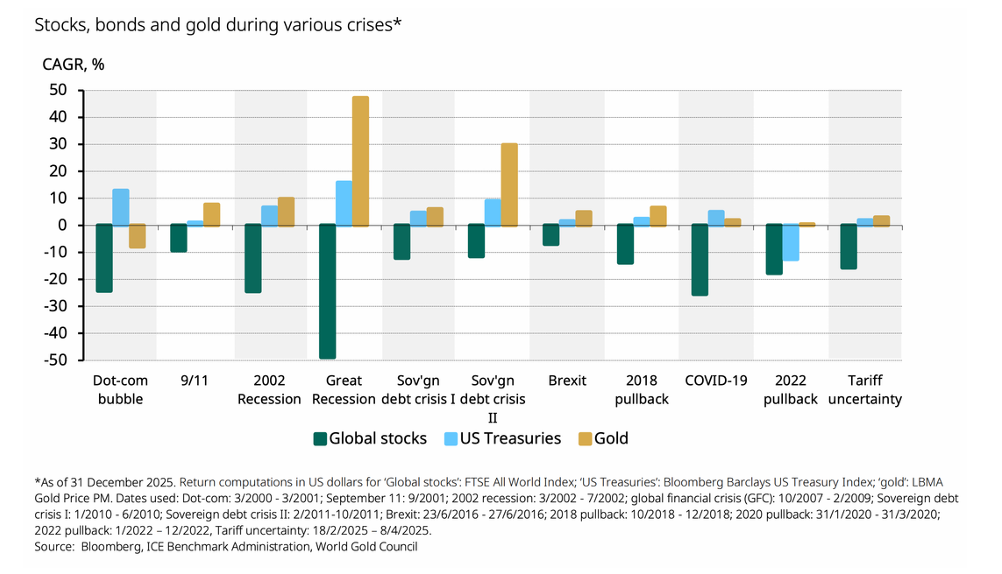
Historically, gold has tended to perform well during periods of crisis. In the 1970s, for example, high inflation and currency weakness drove a significant increase in the gold price. Similarly, during the global financial crisis in 2008, gold held up far better than equities.

In contrast, during strong equity bull markets, such as the 1990s, gold generally lagged. Gold also tends to lag in environments characterised by strong economic growth, low inflation, and rising real interest rates. In these conditions, income-generating assets such as equities and bonds are typically more appealing.

A strengthening US dollar can also act as a headwind, as gold is priced in dollars and becomes more expensive for non-dollar investors.

Different Ways to Access Gold

There are several ways to invest in gold, and the distinction is important.

Holding physical gold itself, such as Krugerrands, or investing through a gold-backed exchange-traded commodity provides direct exposure to the metal itself. This is generally considered the purest form of investment and is often used as a form of portfolio insurance, particularly against extreme or unexpected market events.

Gold mining companies, on the other hand, are fundamentally different. While their earnings are linked to the gold price, they are still operating a business. This introduces a range of additional risks, including rising input costs, operational challenges, labour disruptions and capital allocation decisions.

Because of this, gold mining shares tend to behave more like equities than gold itself. They can outperform the gold price during strong bull markets due to their operational leverage, but they can also underperform significantly during downturns. As a result, they are typically viewed as equity investments with commodity exposure, rather than a pure hedge.

Is Gold a Reliable Hedge?

In the short term, gold can be incredibly volatile and does not always behave as investors expect. During periods of market stress, gold often falls initially due to its liquidity as investors sell what they can, not what they want. Similarly, when real interest rates (nominal rate minus inflation) are rising, it offers no income and becomes less attractive relative to cash or bonds.

However, over the long term, gold has demonstrated its value as a hedge, both through its negative correlation to traditional assets and its ability to preserve purchasing power.

During times of geopolitical instability, gold acts as a neutral reserve asset. Central banks have become increasingly important buyers in recent years, using gold to diversify reserves and reduce reliance on the US dollar. This trend has been particularly evident in emerging markets, where reserve diversification has become a strategic priority.

In addition, gold has shown an ability to preserve purchasing power in inflationary environments. Since 1971, it has outpaced both the US and global consumer price indices (CPIs), demonstrating its ability to protect investors against inflation.

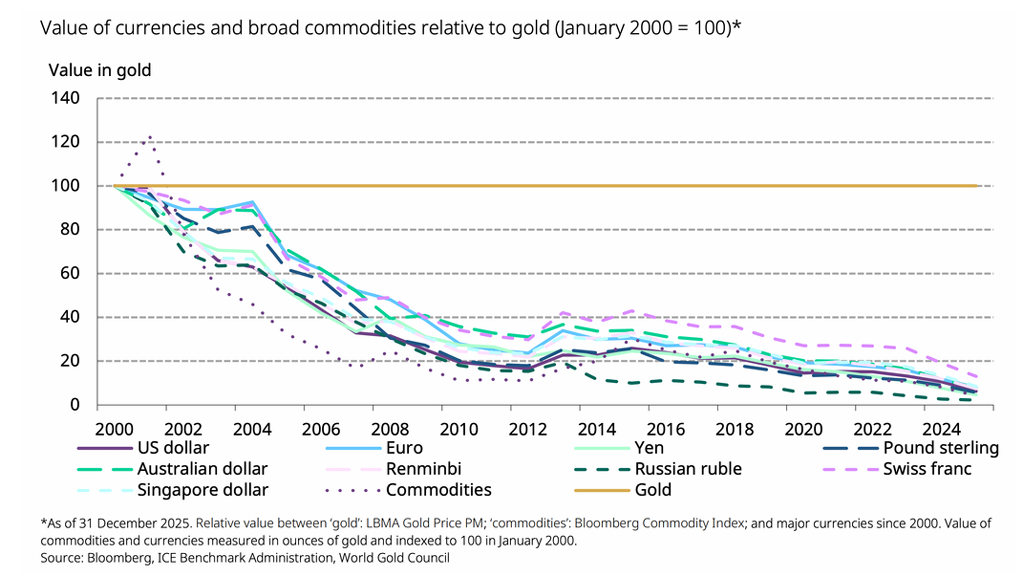
This ties into one of gold’s most enduring roles: acting as a hedge against monetary debasement. When central banks “print” money to stimulate economies or manage government debt, the total supply of currency increases. Because gold’s supply is finite and cannot be created on demand, it tends to retain its value while the purchasing power of paper currency is diluted. Put simply, gold is not becoming more valuable in real terms. It simply reflects the gradual erosion of purchasing power in fiat currencies.

In conclusion, gold should be viewed as a portfolio stabiliser rather than a return driver. Its primary role is to provide diversification and protection during periods of uncertainty, rather than to generate long-term growth.

For most investors, particularly those already invested in diversified portfolios, exposure to gold is often already incorporated. Holding additional physical gold is therefore usually unnecessary.

In a world that is becoming increasingly digital and complex, there is a fundamental value in the physical and the simple. Gold doesn’t require a password, a functioning power grid, or a government’s promise to exist.

Ultimately, gold earns its place in a portfolio not by outperforming in good times, but by providing resilience when it is needed most.

Why This Oil Shock May Be Different

Oil markets have endured many shocks over the past half-century. Embargoes, revolutions,wars, and high-stakes geopolitical negotiations have all driven sharp price moves and unsettling headlines. This has left us asking the age-old question: Is this time different? In our view, what distinguishes the current episode is not simply the degree of volatility, but the
nature of the disruption itself.

For the first time in modern history, the Strait of Hormuz – the most critical artery in the global energy system – has been effectively taken offline at scale. Not legally closed, but operationally disabled in a way markets have never previously had to price.

How Past Oil Shocks Differed

Historically, oil shocks have originated from upstream supply decisions or production failures, not from the breakdown of the transport mechanism that connects producers to the world. A look back on previous oil crises illustrates this:

  • 1973–74: Arab Oil Embargo: This shock was more political in nature. Exporting nations chose to restrict supply in response to geopolitical events, but oil continued to flow through Hormuz. The constraint was imposed at the source, removing roughly 7% of global supply, significant, but operationally contained.
  • 1978–79: Iranian Revolution: Supply fell sharply as Iranian production collapsed amid domestic upheaval. Prices surged, and inflation followed, but once again the Strait remained open. This was a production shock, caused by a political incident, not a chokepoint failure.
  • 1980s: The Iran–Iraq “Tanker War”: This episode is the closest historical parallel to the present situation. Tankers were attacked, mines were laid, and insurance costs rose sharply. Yet shipping continued, often under naval escort, most notably during the US-led Operation Earnest Will. While the strait was dangerous, it was never completely shuttered.
  • 1990–91: Gulf War: Iraqi exports were removed almost overnight. Prices surged, but other Gulf producers responded by increasing output and spare capacity absorbed much of the shock. Throughout the conflict, Hormuz remained functional, and the system adjusted and absorbed the supply change.
  • Post-2000 Threats (2008, 2012, 2019): Since the turn of the century, there have been several threats from Iran to close the strait; however, none led to any prolonged or meaningful impact. Markets repriced risk briefly, oil spiked, and each time shipping continued, and the threat faded without incident.

Across all these episodes, one feature was constant: the plumbing of the global oil market kept working.

What Could Make This Episode Different

The current disruption represents a potential structural break rather than a replay of familiar history. For the first time, the Strait of Hormuz has been functionally removed from service even if no formal closure has been declared.

Tanker traffic has all but come to a standstill:

Commercial shipping through the strait has slowed to a trickle as insurers withdraw cover, shipowners refuse transit, and crews invoke war risk clauses. In practical terms, this is equivalent to closure for much of the market. In previous crises, tankers sailed, sometimes nervously or sometimes under escort. As of today, most simply choose not to set sail at all.

The scale of supply at risk is unprecedented:

Approximately 20% of global oil supply, along with a material share of liquid natural gas (LNG) exports, normally transits Hormuz. That is more than double the scale of any prior oil shock. Independent research groups have characterised this as the largest oil supply disruption on record, not because every barrel has disappeared, but because access to them has been simultaneously lost.

There is no meaningful spare capacity buffer:

In prior shocks, spare capacity elsewhere in the system helped stabilise markets. Today, spare capacity is limited and largely stranded behind the same bottleneck. Producers willing and able to increase output cannot easily move barrels if tankers cannot transit. This materially reduces the market’s ability to self-correct.

The bottleneck itself is the target:

Previous shocks removed supply by damaging fields, toppling governments, or imposing embargoes. This one disables the artery, not just the organ. Energy systems can often absorb the loss of a producer. They struggle far more when the transport mechanism fails. Disabling Hormuz affects the entire Gulf simultaneously.

The risk is systemic, not cyclical:

The International Energy Agency (IEA) and other leading energy bodies have described this scenario as a systemic risk to the global energy system. Once a chokepoint is shown to be vulnerable, the risk does not simply evaporate when political rhetoric softens, or ceasefire discussions begin. Insurance costs, shipping behaviour, and risk premia tend to reprice
permanently. The genie does not go neatly back into the bottle.

Why Markets Are Struggling to Price It

Equity markets are well-practised at absorbing policy shocks. They are far less comfortable with physical constraints.

The sharp oscillations in oil prices, spiking on disruption headlines and retreating on hopeful commentary, suggest investors remain anchored to historical playbooks that assume oil shocks are temporary, political, and ultimately reversible. This one may not be. That does not mean alarm is warranted. It does mean that complacency could be misplaced.

What We Are Watching

Our focus remains on signals rather than headlines. With no shortage of noise present, the signals that matter the most are:

  • Physical shipping data: Evidence that insurers, shipowners, and crews are genuinely willing to resume large-scale transit through the Strait of Hormuz.
  • Inventory drawdowns: The pace at which global oil and refined product stocks are depleted if disruption persists.
  • Policy responses: Coordinated releases from strategic reserves and the limits of their effectiveness where transport constraints remain unresolved.
  • Second-round effects: How higher energy costs feed into inflation, consumer confidence, and ultimately earnings expectations.
  • Market behaviour: Whether risk assets continue to treat this as a temporary scare or begin pricing a more persistent energy shock.

Periods like this are uncomfortable by design.

They force repricing, challenge assumptions, and test portfolio discipline. They also tend to create opportunities for investors willing to separate genuine volatility from permanent impairment.

Markets have navigated oil scares before. What they have not navigated is a sustained, large scale disruption to the world’s most important energy chokepoint. That difference deserves attention – not fear, but a level of respect.

US Iran Conflict: A Regime Overhaul

US Iran Conflict: A Regime Overhaul

Early on Saturday morning, 28 February, the US and Israel launched joint attacks on Tehran, the capital city of Iran. In the early stages of the attacks, a building occupied by Iran’s Supreme Leader, Ayatollah Ali Khamenei and many other senior officials was destroyed, leading to their deaths. In retaliation, Iran launched strikes against the US and Israel as well as neighbouring Gulf countries. Why have these events occurred, and what does it mean for markets? We unpack these themes throughout the article.

Why did the US Attack?

According to the US, Iran is a long-designated state sponsor of terrorism – a title it has held since 1984. In June 2025, the US supported Israel in an attack to neutralise Iran’s nuclear program by striking any facilities associated with the development of nuclear weapons. Moving forward to February 2026, a series of diplomatic discussions had been held between the US and Iran regarding halting the funding of terrorist organisations, dismantling their ballistic missile program and refraining from redeveloping nuclear weapons. Accepting these terms could lead to reduced sanctions on Iran, opening it up to world trade. But no agreement was met.

Parallel to the diplomatic discussions, there have been mass protests in Iran against the current regime due to ongoing economic instability. This has resulted in the government turning on its citizens with force, leading to mass casualties.

The US believed that overhauling the current regime would be the best outcome for the world and the people of Iran, which is why they moved ahead with Operation Epic Fury.

Could this Mean WWIII?

Given the information available, it is highly unlikely. Iran has close to no support from other nations (other than its regional proxies), no nuclear weapons and substantially less firepower than the US and Israel.

Despite eliminating the Supreme Leader of Iran, there is reason to believe the war will go on a little longer. Unlike Venezuela, which was largely a dictatorship governed by one man, Iran has a far more institutionalised governance structure that goes beyond the Supreme Leader. Therefore, to achieve a full regime change, the US would need to eliminate all potential successors that represent the old regime.

It is impossible to predict outcomes, however probabilistically, Iran is unlikely to surrender until they have exhausted their firepower, so hostilities are likely to continue unless a resolution is reached. Iran has threatened to bomb any oil tankers passing through the Strait of Hormuz, which facilitates ≈20% of the world’s daily petroleum and ≈20% of the world’s liquified natural gas (LNG). They attacked oil refineries in Saudi Arabia, LNG facilities in Qatar and tankers in the Gulf as a strategy to disrupt global oil markets. Iran supplies ≈3% of global oil, which is likely to be disrupted as the war continues.

How have Markets Reacted?

Oil prices rose sharply as future supply is perceived to be reduced following the destruction of oil and LNG production facilities in the world’s largest producers, along with uncertainty around oil production out of Iran due to the war. OPEC+ has announced it will increase production to stabilise prices, but there is a significant risk in execution as logistical avenues are blocked.

Initially, there was a major risk-off movement in the markets, which saw the gold price rise and the dollar strengthen. Interestingly, since the initial spikes, gold has sold off slightly but remains at higher levels; however, the dollar has continued to strengthen. Stocks that have benefited from the attack include defence companies driven by higher perceived future demand for weapons and oil companies, which benefit from higher oil prices. The S&P 500 and Russell 2000 declined as markets opened on Monday, 2 March, but closed the day relatively flat as losses reversed.

A rate cut was expected in the US, but with oil prices surging, it is unclear what impact this will have on prices. Therefore, an interest rate decision is likely to be delayed until there is a better line of sight.

In South Africa, the rand weakened from 15.95/$ on Friday to 16.30/$ around midday on Tuesday, 3 March. The FTSE/JSE All Share Capped Index closed down -1.13% on Monday, 2 March, but had declined a further -5.1% by late afternoon on Tuesday, 3 March. Initially, gold shares appeared to keep the index buoyed with a sharp rise in the gold price, but as gold fell from its peak, this led to a broad market sell-off, pushing stocks lower.

South Africa imports a lot of its inflation through oil prices and a weak currency. Therefore, with both working against us, this has created uncertainty around price stability. The SARB was expected to cut interest rates, but may now hold off its decision just like the US. The large sell off in SA stocks could be driven primarily by higher imported inflation, delayed rate cuts and a risk-off environment. This raises concerns but does not appear to be a long- or even medium-term concern, as it is unlikely the war will proceed for this long. Facilities will be rebuilt, and trade routes will open, which may reverse the movements we have seen.

What is the One Thing that Matters?

Given the facts, the war is expected to continue for a few more weeks if no diplomatic agreements are reached despite pressure from the Gulf nations. Markets will remain volatile as traders and investors attempt to forecast the future of the war. In the short term, markets will prioritise reducing risk and move towards safe-haven assets or companies poised to benefit from the war and disruption (i.e. oil and defence stocks). Naturally, these positions can reverse with a ceasefire and stabilised oil price, so trying to position into what seems favourable can be futile.

In times like these, diversification is your best friend, while looking long-term should be your guiding light. History shows that stock markets have excelled as wars have come and gone. While these events are serious, we do not see them as being different from the past; as always, we will continue to monitor markets and ensure our long-term positioning is prudent.

SA Budget Speech 2026: The Stone Keeps Rolling

South Africa has been riding a wave of positive economic momentum with a stronger currency, healthy inflation and lower bond yields. While this has resulted from a combination of supportive local policies and global factors, it has provided a suitable platform to bring about change. One of our biggest risks in maintaining this momentum would be to miss this opportunity by failing to implement favourable economic policy. The budget speech covered many sectors; however, focusing on what is implemented rather than what is promised helps to ease uncertainty and build confidence, making South Africa more investable.

Debt Has Peaked

A core factor behind our ratings upgrade in November 2025 stemmed from an improvement in our primary surplus, which was announced in the Mid-Term Budget Policy Statement. The primary surplus was revised slightly higher at 0.9% for the latest fiscal year, 2025/2026, and is expected to grow to 2.3% by 2028/2029. The primary surplus measures the difference between a government’s tax revenue and its expenditures, excluding any interest payments.

As the primary surplus grows, it should strengthen the national balance sheet and reduce gross debt-to-GDP, which is believed to have peaked at 78.9% and is forecast to decline to 76.5% by 2028/2029. While these appear to be small reductions to a giant number, it is important to note that how we view debt as individuals cannot be directly compared to a country’s debt. A country is an entity that never ceases to exist; it can’t run, and it can’t hide. Stabilising debt at levels higher than 80% for a prolonged period is not problematic if debt repayments are made. A country doesn’t need to pay off its debt; it can always be indebted if the debt is put to good use.

Nonetheless, the government’s willingness to cut spending and repay debt highlights discipline and focus on sustainability. Real economic growth is forecasted to be 1.6% for 2026, reaching 2.0% by 2028, which is underwhelming for an emerging market such as South Africa. Unfortunately, the Zuma era robbed us of utilising debt for growth, and now we are left with the aftermath. A long-term focus has been adopted, starting with foundational reforms that should ultimately translate into a stronger investment landscape.

Tax Relief for Savers, Givers & Homeowners

To encourage saving, an overdue increase in the tax-free savings account (TFSA) annual contributions limit from R36 000 to R46 000 was announced. This change is just above inflation since its last change in 2021. Unfortunately, the lifetime contribution cap of R500 000 remains in place, meaning the earliest investors will reach the limit by 2028/2029.

For the first time in 10 years, the Treasury increased the annual contribution maximum for retirement funds from R350 000 to R430 000 (or 27.5% of taxable income). While this disproportionately benefits a smaller group of higher-earning individuals, it does result in capital flowing back into markets, which is reallocated to productive areas that stimulate growth. The beauty of the financial system.

Capital gains exclusions on primary residences increased from R2 million to R3 million, which is aimed at protecting the middle class. The last time this was adjusted was in 2012, and housing prices have risen substantially since then. The change has been introduced to stop taxing homeowners on inflationary gains and focus on real gains. The exemption on donations tax increased from R100 000 to R150 000, helping parents support their children with deposits for homes, student debt, or even starting businesses.

By allowing wealth to remain in individuals’ hands, the government is betting it will be reinvested in the local economy rather than going to pay down debt if it were taxed.

Small Business Wins

Small businesses form the backbone of any economy, and seeing the sector receive some positive adjustments is reassuring. The VAT registration threshold, which represents the amount of turnover a business must earn to register as a VAT collector, increased from R1million to R2.3 million, marking its first change since 2009. Businesses under the new limit could theoretically free up 15% of their turnover to reinvest in the business.

Capital gains tax is often a consideration when deciding to sell an asset. Sellers may be unwilling to incur tax charges and may hold onto assets for longer periods until a more favourable environment arises for selling. The finance minister announced that the capital gains tax exemption for small business owners aged 55 or older will be raised from R1.8 million to R2.7 million. As tax relief is provided, capital markets open up, and there is likely to be more transaction activity and investment.

These adjustments indicate that the government is willing to forgo tax revenue to cultivate small-business growth in the country. This reflects a long-term stance, as smaller businesses face a lower tax burden, have access to more capital for investment, can reduce unemployment, and contribute to economic growth.

Yet to Be Implemented

There are many areas of the economy that are in dire need of attention, including infrastructure, municipal government, education, healthcare and crime. The budget highlighted these as core areas for improvement, but right now, it is a ‘wait and see’ story. Confidence is a challenge to build and easy to destroy, which means that meaningful, effective execution in each of these sectors is critical. We need to see improvement in local municipality service delivery; we need to see crime numbers come down and education numbers go up before confidence starts to compound.

How Did the Markets React?

Stabilising debt levels, spending discipline and a marginally more positive environment for investors, savers and consumers resulted in the JSE All Share Index rising by 1.26%; 10Y bond yields declined by 0.14%, and the rand strengthened by 0.7% for the day. By no means are these numbers outstanding or fully attributed to the speech itself, but when assessing the bigger picture, our positive confidence streak continues.

Looking Ahead

The key takeaway is the stabilisation in debt: our debt-to-GDP is forecasted to have peaked, and our primary surplus is expected to grow. To achieve economic growth, South Africa needs to be made as investable as possible. There is still a long road ahead, but if we have debt under control and the means to pay it off, then we have proven to investors that we are not as risky an investment. Unstable debt levels create this image.

Debt that becomes due will be refinanced at some of the lowest rates we have seen in at least 10 years, which will snowball into lower interest payments, a lower debt burden, and maybe even lower yields and a stronger currency.

Many policy changes mentioned in the article were made in line with, or still lag, inflation from their last adjustments. However, the past is the past, and when assessing how different these policies were a year ago, there are some substantial changes that will hopefully unlock more capital to be reinvested into our country.

Venezuela: Oil Rich, Governance Poor

Over the last couple of days, social media, news outlets and broadcasting channels have blown up over the news regarding the ousting of the Venezuelan president, Nicolás Maduro and his wife, Cilia Flores. The world has given mixed reactions with part in support of toppling a dictatorship while others are in protest over violating international law. Maduro is set to face narco-terrorism conspiracy, cocaine-importation conspiracy and weapons charges in the US and will stand trial in the coming weeks.

Where the finance world has shown greater interest is in the vast wealth of oil reserves located throughout Venezuela and what it means for markets now that the US will work closely with Vice President Delcy Rodríguez as she steps into the presidency role in the interim.

Background To The Venezuelan Oil Industry

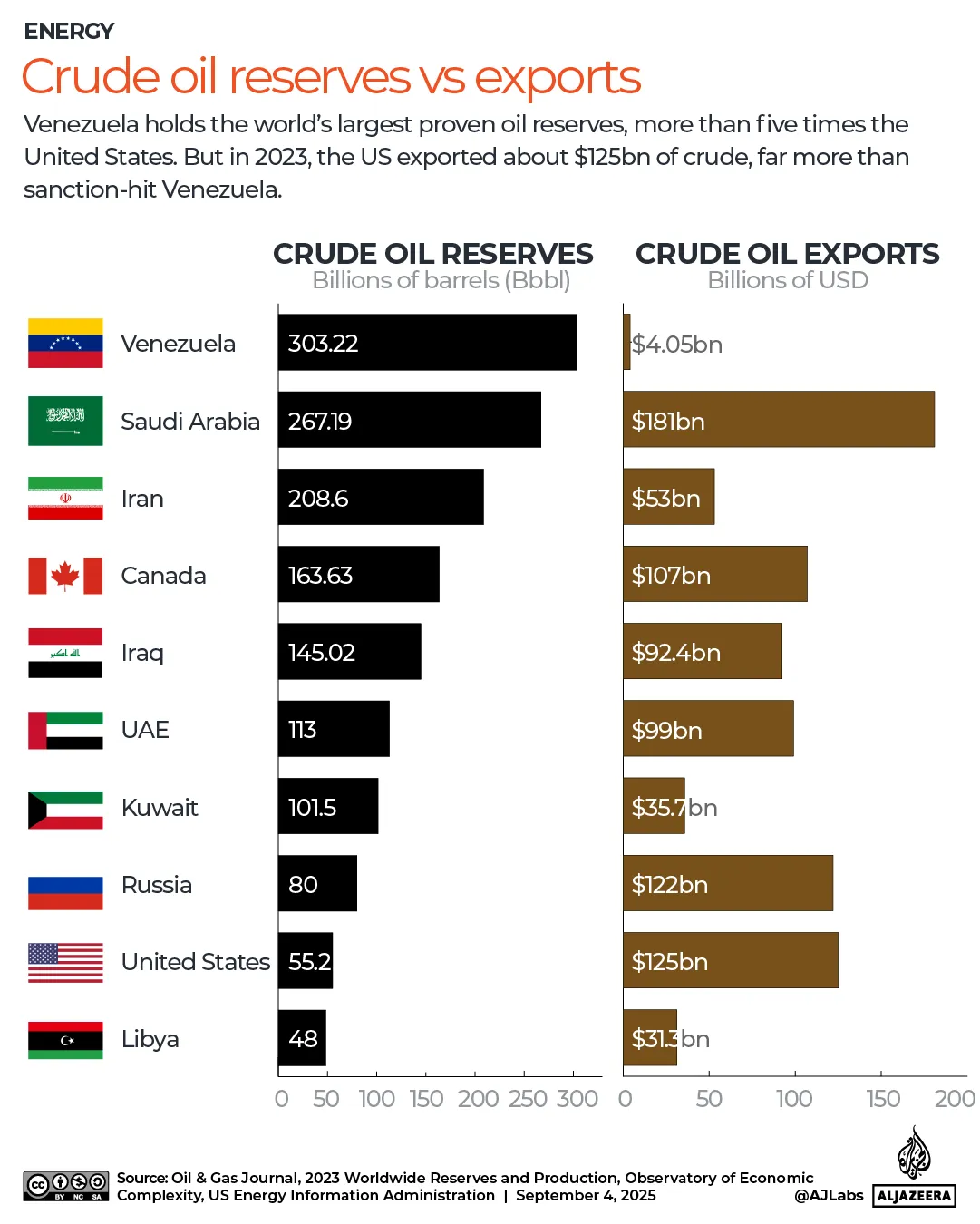
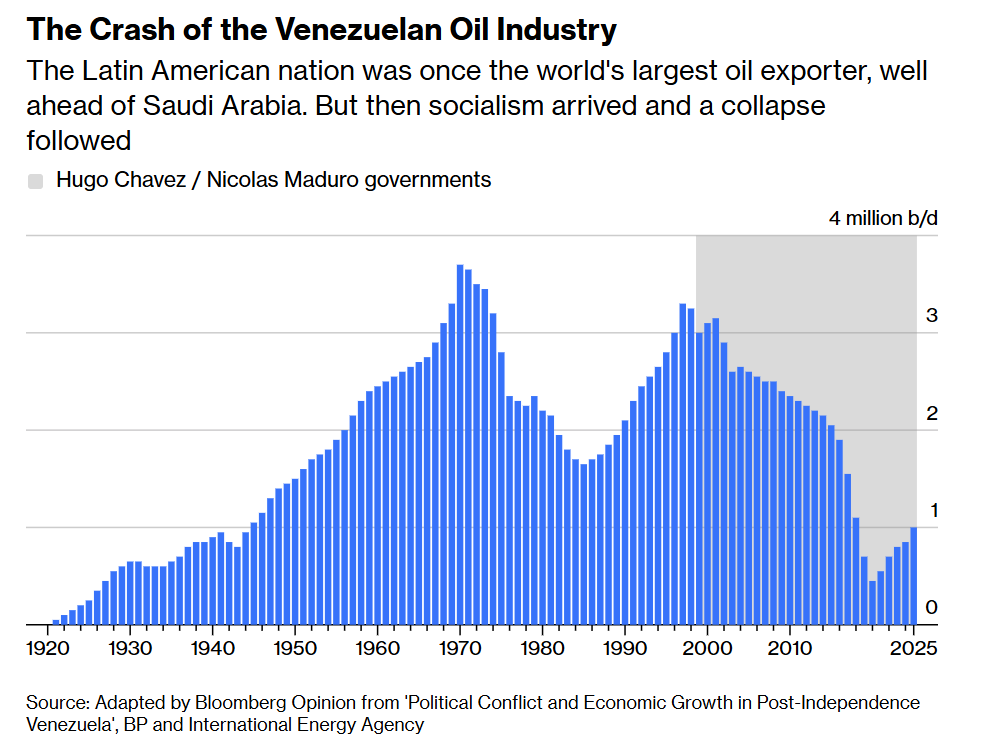
Venezuela is estimated to possess 303bn barrels of crude oil (~17% of the global oil reserves) making it the most oil rich country in the world. The Venezuelan government nationalised the oil industry in the 1970s during which the country was producing 3.5 million barrels per day (~8% of global oil production) and contributed ~1% to global GDP. Over the last 50 years, high-level corruption during the Chavez and Maduro regimes placed the country into a state of disrepair with hyperinflation and real GDP declining by 70%. Today, Venezuela only produces 0.95 million barrels per day (~1% of global oil production) and contributes 0.1% to global GDP. Many US oil companies were chased out of the country over this time with assets seized by the government and little to no remuneration.

Source: Aljazeera
Source: Bloomberg

The Role Of The US

The existing oil infrastructure is in a poor state of condition, and the US is planning to invest and develop the oil industry to its former glory. This is by no means cheap and quick and is estimated to require over $100bn in investment over the next decade. In addition, US oil companies will want solid reassurances that there will be stability in Venezuela before opening for business. Therefore, in the short- to medium-term it is highly unlikely we will see a massive surge in oil supply and decline in the oil price but rather a gradual change as infrastructure is redeveloped and as incremental supply enters the market.

It is likely that Venezuelan oil exports will be halted in the short-term as the industry navigates the uncertainty and reconsolidates. Currently, the global oil market is believed to be in a state of ample supply and given that only 1% of the global oil supply is supplied by Venezuela (with most of it being sanctioned) no material impact on the global economy is expected.

What Does This Mean For The Markets?

When markets opened on Monday, gold rallied, European defence stocks moved up, oil companies received a boost in premarket trading and oil prices traded up marginally but for broader markets it was just a normal day. History has shown that during similar moves by the US in Iraq, Syria, Iran, etc. had short-term drawdowns reversed quickly after the event occurred if there were any drawdowns at all.

This is still a developing story but given the facts it appears markets will not react adversely where a change will be warranted in portfolio construction. The move appears to be more geopolitical in nature than economic as the US tries to resist China and Russia, who had a large presence in Venezuela, from achieving the upper hand in the global race for power. Economic benefit to the US is likely in the long-term but still uncertain as the Venezuelan economy is required to stabilise.

The value of a Tax-Free Savings Account

In his Budget Speech, the Minister of Finance announced an increase in the annual Tax-Free Savings Account (TFSA) contribution limit from R36,000 to R46,000 – the most significant boost to this allowance in years, and a timely reminder of just how powerful this vehicle can be.

When used properly, it can deliver returns that are completely tax-free, not just today but for life. While TFSAs are flexible, their true potential lies in long-term investing, allowing your capital to compound over decades. In this article, we’ll explore why a TFSA can outperform other investment options, how to make the most of your contributions, and what strategies can help you maximise your long-term growth.

Before strategy, the non-negotiables:

  • Effective 1 March 2026, you may contribute up to R46,000 per tax year (between 1 March and 28 February). This has been increased from R36,000.
  • You may contribute a maximum of R500,000 over your lifetime.
  • If you withdraw money, you cannot contribute it again.
  • Overcontributions are penalised at 40% of the excess amount.
  • All interest, dividends, and capital gains are tax-free forever.

Although a TFSA allows withdrawals at any time, it is not intended as an emergency fund. The real value comes from leaving it invested for as long as possible and letting compounding do the heavy lifting. Once money is withdrawn, that portion of your lifetime limit is gone for good. Let’s explore why a TFSA can outperform other investment options, how to make the most of your contributions, and what strategies can help you maximise your long-term growth.

1. Should I contribute to a TFSA or a Retirement Annuity?

The key difference:

  • TFSA contributions are made with after-tax money, but all growth and withdrawals are tax-free.
  • Retirement Annuity (RA) contributions are tax-deductible, but withdrawals in retirement are taxed.

This means a RA contribution only adds real value if the tax saved today is greater than the tax paid later.

As a general guideline, investors in lower- to moderate-tax brackets, often around 31% or below, may benefit from prioritising TFSA contributions first. At these levels, the immediate tax deduction available through an RA is less significant, while the TFSA allows capital to grow tax-free over long periods of time.

There’s also flexibility to consider:

  • RAs have strict access rules. Before age 55, access to the investment is very limited. At retirement, up to one-third may be taken as a lump sum, subject to the retirement lump sum tax tables. The balance can be taken as an annuity which pays out a monthly income, which is subject to income tax.
  • RAs are constrained by Regulation 28, which limits offshore exposure to 45%, whereas TFSAs allow full offshore equity exposure, which has historically delivered higher long-term growth*.

There is no one-size-fits-all answer. The right balance depends on your income, tax rate, and long-term goals. This is where proper planning matters.

*Some providers may have platform limitations on offshore exposure.

2. Why invest in a TFSA rather than a flexible investment?

To understand the real power of a TFSA, let’s compare it to a flexible investment. This removes the flexibility constraints the RA has.

Assumptions:

  • Contributing R46,000 per year, at the start of the tax year, until the R500,000 threshold has been met.
  • Capital return of 12% p.a. return on the TFSA and flexible investment.
  • No withdrawals until year 30.
  • Effective capital gains tax at 18% at the end of the 30-year period.

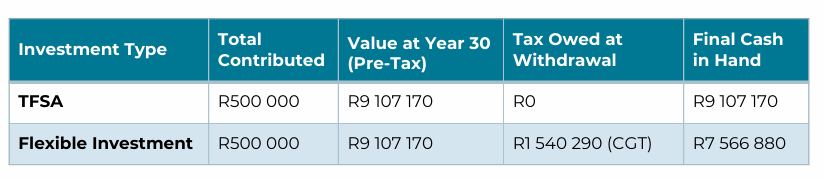
Same contribution. Same return. A R1.54 million difference, purely due to tax.

3. How should you invest in your TFSA?

As the biggest benefit of a TFSA is the savings on capital gains tax, the best way to maximise the growth is to invest in high-growth assets. This typically means a portfolio with high exposure to equities, especially offshore equities. Typically, this type of portfolio returns at least 12% p.a.

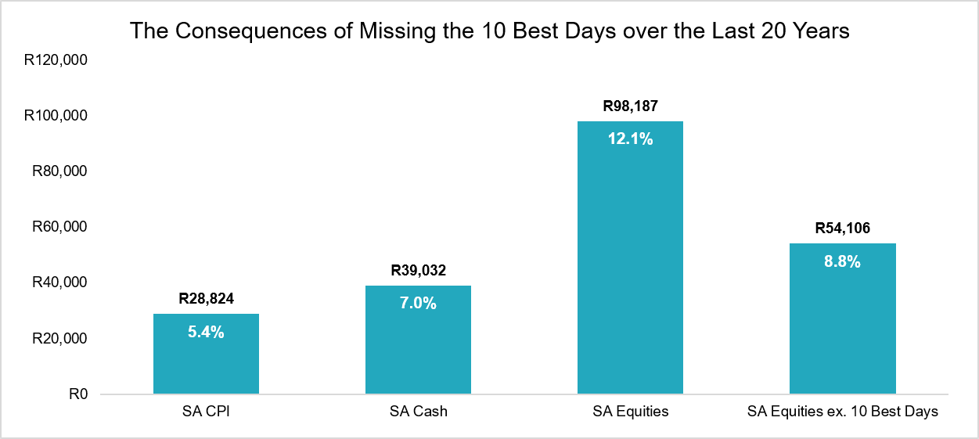
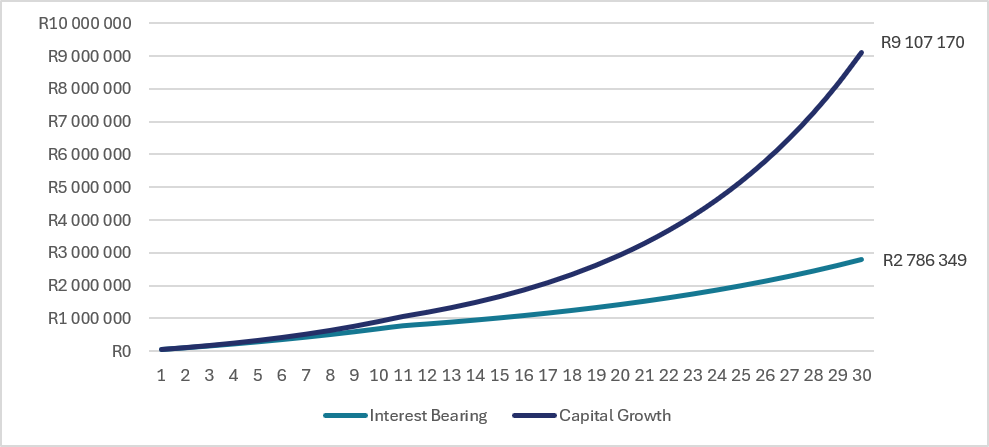
So, why is your bank offering you a TFSA? Well, because the tax benefit of not paying interest on your capital is also substantial. However, a tax-free return of 7% is still less than a tax-free return of 12%. It can mean a difference of R5.4 million after the 30-year period. Therefore, maximising the return you can get is essential to long-term performance.

4. Is there a material difference between contributing R3,833.33 p.m. at the start of each month or R46,000 every year in March?

Yes, there is a marginal mathematical advantage to contributing R46,000 at the start of the tax year rather than R3,833.33 per month. With annual contributions at the start of the year, more money is invested earlier, allowing compounding to get a head start.

Over a 30-year period, the investor who contributes annually upfront ends up with R453,748 more.

However, here’s the part that matters more than the spreadsheet. If contributing annually means the money sits in your bank account and somehow “disappears”, then the strategy has already failed. For many investors, a monthly debit order is far more effective than relying on discipline and timing a large lump sum once a year.

Consistency beats optimisation. A TFSA that is funded every month, every year, will always outperform a TFSA that was supposed to be funded annually but never quite gets around to it.

If a monthly debit order is what ensures the contribution actually happens, then that is the better strategy. Always.

Investing in a TFSA isn’t just about saving, it’s about supercharging your wealth over time. By keeping your funds invested, prioritising high-growth assets like equities, and contributing consistently, you can take full advantage of the tax-free benefits.

Speak to your financial planner today to ensure your TFSA is working as hard as possible for your financial future, because when it comes to compounding, every year counts.

Key takeaways: Why a TFSA matters

  • A TFSA allows all growth and withdrawals to be completely tax-free for life, making it one of the most powerful long-term investment tools available.
  • Contributions are limited (R46,000 per year, R500,000 lifetime), so starting early and staying invested is critical.
  • Once money is withdrawn, that portion of your lifetime limit is lost forever. TFSAs reward patience, not flexibility.
  • When invested in high-growth assets like equities, a TFSA can materially outperform an interest-bearing TFSA portfolio and a taxable investment over time.
  • Consistency beats perfection: The best TFSA strategy is the one you actually stick to. A monthly debit order beats the intention of making an annual lump sum.

No More Grey Days for South Africa

Late on Friday afternoon, 24 October, a piece of lost confidence was restored as the Financial Action Task Force (FATF) announced the removal of South Africa from the grey list. The decision came after South Africa executed the necessary action items laid out by the FATF, bringing the country in line with global standards.

The FATF, Grey Listing & Why It All Happened

The FATF is an intergovernmental organisation with the sole purpose of combating money laundering and terrorist financing. By implementing global standards and holding nations accountable, they promote confidence in the systems and institutions underpinning payments, transactions, and investments. A financial system rife with criminal activity leads to problematic outcomes within an economy, including:

  1. Lack of financial integrity
  2. Economic instability
  3. International sanctions
  4. Corrupt governance

Effectively, the FATF to stop criminals from using the financial system to store, increase, or disguise the origin of their wealth. If Pablo Escobar was able to open a bank account with one of our local banks to store his illegal profits or open an investment account with one of our asset managers to grow his wealth without the institutions knowing who they were doing business with, it opens up the financial system to widespread abuse. Criminals become wealthy enough to bribe the government and influence policies, own and run public companies and continue to engage in activities that reduce the welfare of a country.

Earning a place on the grey list indicated risk and uncertainty in South Africa’s financial markets, which international investors avoided. Similarly, any local businesses attempting to partner with international institutions offshore were met with stricter compliance hurdles, making international relationships a greater challenge.

A big ‘KYC’ movement was the key to getting off the grey list. Institutions needed to know who and where they were receiving money from and only accepting the legit sources while declining the dodgy sources. This made it harder for the “Escobars” to conduct their illegal activities. In addition to identification, prosecution was another major flaw that needed to be rectified. In other words, we knew who the criminals were but did nothing about it.

South Africa got its A into G as it increased compliance measures, made necessary arrests and asset seizures so that, 33 months later, it earned its removal from the grey list. Removal had been highly anticipated by markets for a few months, which is why there were no fireworks from markets on Monday. While the move may not be a catalyst that leads to a market rally, it should be seen as a stabiliser for financial markets. Moving forward, our stocks, bonds and currencies may be a little less volatile than before. Coming off the grey list is not a once-off accomplishment but a standard that needs to be upheld for that confidence to improve. After all, investing is a confidence game which needs to be built up to see a positive repricing in our assets.

Derisking in South African Asset Classes

An important component of international investing is a country risk premium. Every country has one, and it highlights the return an investor demands from a country given the risk of investing in that country. Investors may be happy with a 5% return from US government bonds, given its prominent position in the global economy, low risk profile and confidence investors have in earning that return, while it is unlikely an investor would be willing to settle for a similar return in South Sudan. A 35% return may be more enticing for an investor to get involved. This 30% difference is made up of many components, but the bulk is dominated by the country risk premium.

Right now, South Africa is perceived as ‘less risky’ than it was a few months ago, which means our country’s risk premium is expected to decline. The movement doesn’t just happen at once but gradually as South Africa proves itself to be a less risky investment. Foreign investment should slowly return, and foreign institutions should be less harsh when doing business with us. As our country risk premium shifts down, investors may be happy to pay more for the assets they invest in, which will push the value of bonds, equities, real estate and other assets up.

Typically, when there is a change in the risk rating of a country, the first assets to benefit are government bonds. They have the lowest level of risk outside of cash and are an attractive place for foreign investors to dip their toes back into the SA market. As trust is built from the short-term into the medium-term equities start to benefit more as their price-to-earnings ratio grow because investors feel more comfortable paying a higher price for R1 of earnings.

What does this mean for us?

At WealthStrat, we are positioned well for the near-term benefits through our overweight exposure to South African bonds, which have already contributed well to our portfolio year-to date. A derisked environment moving forward will likely see us pivot into a higher equity exposure to benefit from attractive risk-adjusted returns.

Overall, increased asset values contribute favourably to economic growth through many different avenues, including stronger business confidence, lower cost of capital for government and companies, the wealth effect among consumers and increased tax revenue to help contain the budget deficit. This may not be the sole answer to South Africa’s economic woes but forms a vital piece in helping achieve an even greater milestone by returning to investment-grade status in the global economy.