

Gold as an Investment

Liza Brink
Gold has long held a special place in human history, both as a form of currency and a symbol of wealth. While thousands of companies and hundreds of currencies have gone to zero over the past century, an ounce of gold remains an ounce of gold.
In recent years, amid persistent inflation concerns, geopolitical tensions, and uncertainty around global growth, the question of whether investors should hold gold has become increasingly relevant once again.

What Gold Is, and What It Is Not
At its core, gold is a finite, physical commodity. Unlike equities, it does not generate earnings or pay dividends, and unlike bonds, it does not provide any form of income. Its value is therefore not based on cash flows, but rather on what investors are willing to pay for it at a given time.
Its value is underpinned by a few key characteristics. It has historically been viewed as a store of value over long periods, supported by its limited supply and continued demand. It has also shown an ability to retain purchasing power in environments where currencies weaken or inflation erodes the real value of money.
For investors, this means gold should not be viewed as a growth asset. It is not there to compete with equities over the long term, but rather to behave differently when traditional assets come under pressure.
Gold Through the Ages
Gold’s role as a store of value is rooted in centuries of history. Its appeal lies in its scarcity, durability, and the fact that it is universally recognised and accepted.
One of its most important characteristics is that it is not someone else’s liability. Unlike a bond, which depends on a borrower’s ability to repay, or a share, which relies on a company’s profitability, gold’s value does not depend on any institution or issuer. This gives it a unique place within a portfolio.
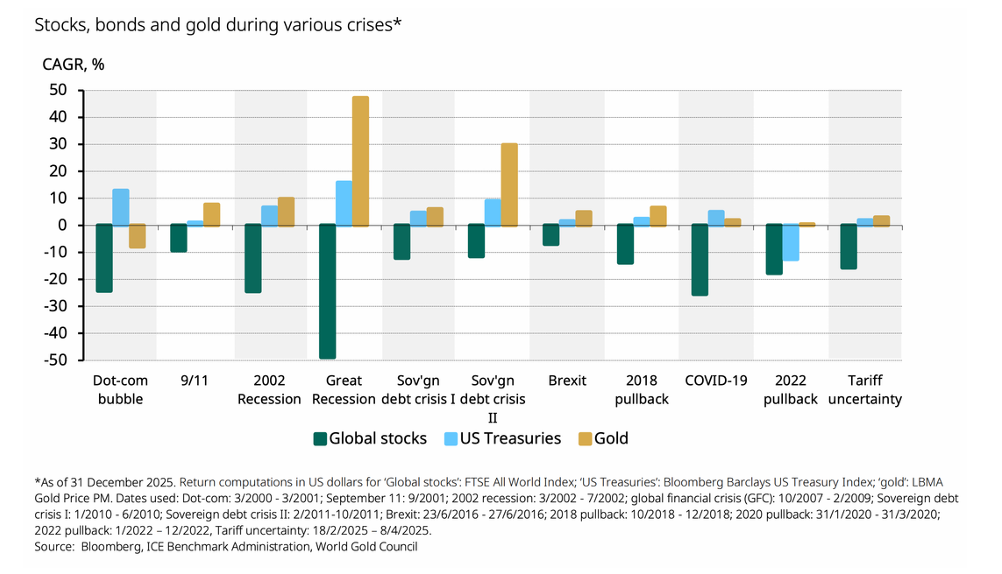
Historically, gold has tended to perform well during periods of crisis. In the 1970s, for example, high inflation and currency weakness drove a significant increase in the gold price. Similarly, during the global financial crisis in 2008, gold held up far better than equities.
In contrast, during strong equity bull markets, such as the 1990s, gold generally lagged. Gold also tends to lag in environments characterised by strong economic growth, low inflation, and rising real interest rates. In these conditions, income-generating assets such as equities and bonds are typically more appealing.
A strengthening US dollar can also act as a headwind, as gold is priced in dollars and becomes more expensive for non-dollar investors.
Different Ways to Access Gold
There are several ways to invest in gold, and the distinction is important.
Holding physical gold itself, such as Krugerrands, or investing through a gold-backed exchange-traded commodity provides direct exposure to the metal itself. This is generally considered the purest form of investment and is often used as a form of portfolio insurance, particularly against extreme or unexpected market events.
Gold mining companies, on the other hand, are fundamentally different. While their earnings are linked to the gold price, they are still operating a business. This introduces a range of additional risks, including rising input costs, operational challenges, labour disruptions and capital allocation decisions.
Because of this, gold mining shares tend to behave more like equities than gold itself. They can outperform the gold price during strong bull markets due to their operational leverage, but they can also underperform significantly during downturns. As a result, they are typically viewed as equity investments with commodity exposure, rather than a pure hedge.
Is Gold a Reliable Hedge?
In the short term, gold can be incredibly volatile and does not always behave as investors expect. During periods of market stress, gold often falls initially due to its liquidity as investors sell what they can, not what they want. Similarly, when real interest rates (nominal rate minus inflation) are rising, it offers no income and becomes less attractive relative to cash or bonds.
However, over the long term, gold has demonstrated its value as a hedge, both through its negative correlation to traditional assets and its ability to preserve purchasing power.
During times of geopolitical instability, gold acts as a neutral reserve asset. Central banks have become increasingly important buyers in recent years, using gold to diversify reserves and reduce reliance on the US dollar. This trend has been particularly evident in emerging markets, where reserve diversification has become a strategic priority.
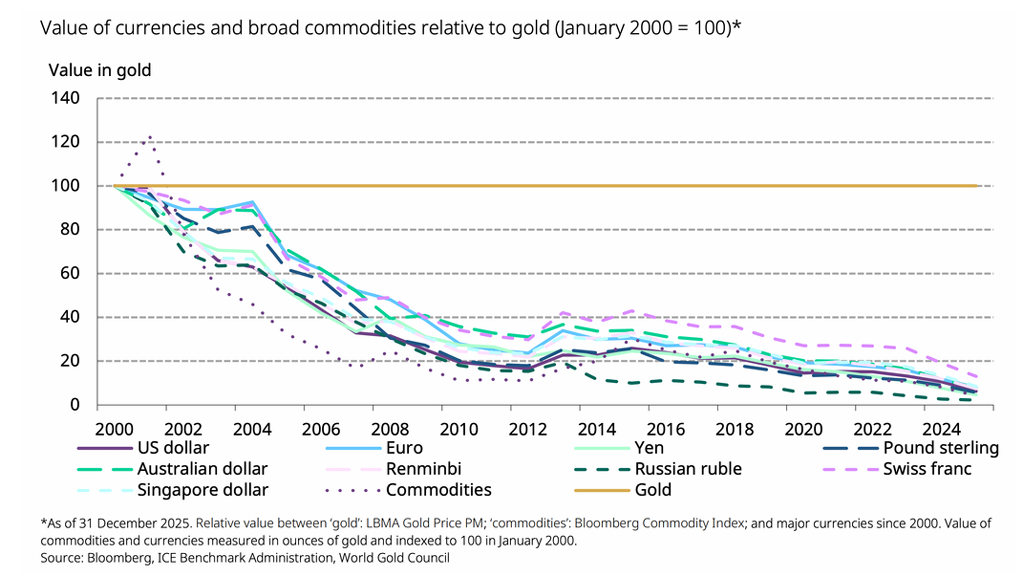
In addition, gold has shown an ability to preserve purchasing power in inflationary environments. Since 1971, it has outpaced both the US and global consumer price indices (CPIs), demonstrating its ability to protect investors against inflation.
This ties into one of gold’s most enduring roles: acting as a hedge against monetary debasement. When central banks “print” money to stimulate economies or manage government debt, the total supply of currency increases. Because gold’s supply is finite and cannot be created on demand, it tends to retain its value while the purchasing power of paper currency is diluted. Put simply, gold is not becoming more valuable in real terms. It simply reflects the gradual erosion of purchasing power in fiat currencies.
In conclusion, gold should be viewed as a portfolio stabiliser rather than a return driver. Its primary role is to provide diversification and protection during periods of uncertainty, rather than to generate long-term growth.
For most investors, particularly those already invested in diversified portfolios, exposure to gold is often already incorporated. Holding additional physical gold is therefore usually unnecessary.
In a world that is becoming increasingly digital and complex, there is a fundamental value in the physical and the simple. Gold doesn’t require a password, a functioning power grid, or a government’s promise to exist.
Ultimately, gold earns its place in a portfolio not by outperforming in good times, but by providing resilience when it is needed most.