

The Role of Cash: When it Works, When it Hurts

James Tucker
There is a long-running debate in the investment world about what to do with cash. Few figures capture the two sides of the argument better than Ray Dalio and Warren Buffett. Dalio famously declared “cash is trash”, arguing that sitting in cash is a slow and silent way to lose money, and that investors who cling to it are simply giving up returns they will never get back. Buffett takes a different view. Drawing on the old proverb that a bird in the hand is worth two in the bush, he argues that cash is not something to be ashamed of; it is a position of strength. Having cash available means you are never forced to sell, never caught off guard, and always ready to act when the market hands you an opportunity. The two views are not as contradictory as they first appear. Both men agree that cash left idle indefinitely is a mistake. Where they differ is in how much respect they give to the value of being ready. Understanding when each position is right can make a meaningful difference to your long-term wealth.
When Cash Works
Advantage 1: A Competitive Return
The first situation is where cash is genuinely the most attractive place to be. This happens when two conditions align: interest rates are high enough to pay a real return after inflation, and shares are priced too high to reward the risk of owning them. When both hold, cash is not a cautious retreat; it is the rational choice.
The South African experience differs meaningfully from most developed markets. After the 2008 financial crisis, central banks in the United States, Europe, Japan, and the United Kingdom held interest rates at or near zero, and some, notably Sweden, Denmark, Switzerland, and the eurozone, pushed them to negative, effectively charging savers to hold money in the bank. There, cash was a guaranteed way to lose purchasing power.
South Africa has been fundamentally different. The South African Reserve Bank has kept interest rates well above inflation through much of the same period, so local money market funds have regularly beaten the cost of living. For a South African investor, cash has at times been a genuinely competitive place to be, particularly when local share valuations looked stretched.
Advantage 2: Dry Powder
The second situation is what investors call having “dry powder”: keeping cash available so that when markets fall sharply and good assets become cheap, you can buy them. Investors who had cash available during the 2008 financial crisis and the 2020 pandemic selloff were able to buy quality shares at heavily discounted prices. The value of that cash was not in the interest it earned while sitting idle; it was in what it allowed them to do when the moment arrived.
When Cash Hurts
Cost 1: The Competitive Return becomes an Opportunity Cost
The first cost is what you give up by not being invested, and for South African investors, this is where the real damage is done. Local money market funds may beat inflation, which feels like a win, but the JSE and global equity markets have delivered returns over long periods that dwarf what cash can offer. An investor who held a meaningful cash allocation through the post-2008 bull market, or through the recovery following the 2020 pandemic selloff, did not just earn a little less. They missed some of the most powerful compounding the market has ever produced. That gap does not just represent a smaller balance; it represents years of growth that cannot be recovered. Inflation-beating cash returns can create a false sense of progress. The investor sees a positive real return and concludes they are doing the right thing, while quietly falling further and further behind the returns that a fully invested portfolio would have generated. Feeling safe and building wealth are not the same thing.
Cost 2: A Positive, Real Return Becomes a Negative One
The second cost is tax, which can quietly undermine the apparent advantage of South African cash. On a headline basis, local cash instruments may still offer a return above inflation, but that is not the same as the return an investor keeps. Interest income is taxed as part of taxable income once the annual exemption has been used, which means the benefit of higher local cash yields is reduced most for investors already paying tax at higher marginal rates. The result is that a pre-tax real return can become far less compelling after tax, and in many cases the investor’s net return may fail to keep pace with the rising cost of living. This is the uncomfortable reality: cash can appear to protect purchasing power before tax, while doing a much poorer job after tax. For taxable investors, the margin of safety is therefore thinner than the headline yield suggests.
Cost 3: The Dry Powder becomes a Timing Trap
The third and most overlooked cost is the timing trap. Holding extra cash because you think the market is going to fall is effectively a bet that you can predict two things correctly: when to get out and when to get back in. The evidence suggests that very few investors, even professional ones, can do this reliably. Share markets tend to deliver most of their returns in short, sharp bursts that are almost impossible to predict in advance. Research consistently shows that missing just the ten best days in the market over a decade can roughly halve your long-term returns. What makes this especially painful is that those best days almost always happen close to the worst days, during recoveries from sharp selloffs. The investor who moved into cash because they were frightened by falling markets is precisely the investor who is most likely to miss the rebound. This is the real meaning behind the phrase “time in the market beats timing the market”: it is not just investment wisdom, it is backed by decades of data.
The chart shows how a R10,000 investment in South African equities, cash and inflation (CPI) would have grown over the 20 years to June 2026, highlighting both the long-term wealth-creating power of equities and the significant cost of missing the market’s strongest days.
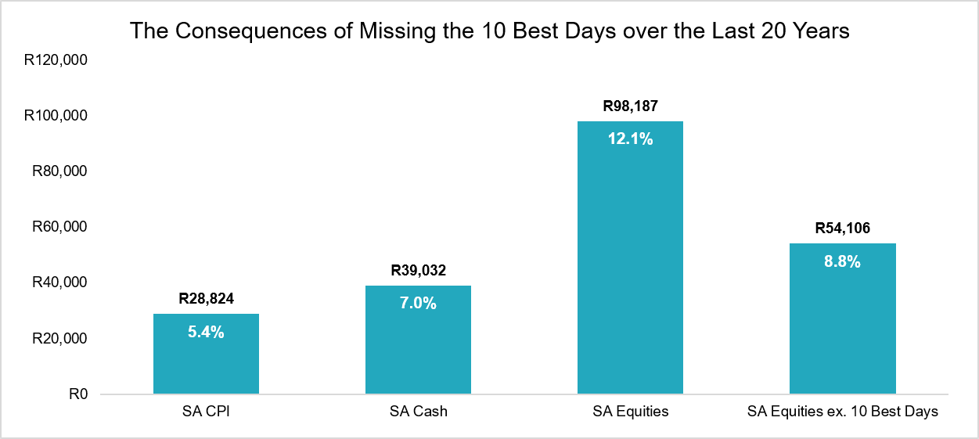
Source: Morningstar Direct. All returns are calculated pre-tax and in ZAR. SA Cash uses STeFI Composite as a proxy and SA Equities uses the FTSE/JSE All Share Total Return as a proxy. Returns are annualised.
Not All Cash Is the Same
It helps to think about why an investor is holding cash in the first place, because the answer changes whether it is a sensible decision or a costly one. Cash needs differ from one investor to the next, but the typical investment period ranges from 0–18 months.
- Cash held for a specific purpose such as an emergency fund, covering upcoming expenses, or matching a known future liability, is entirely rational regardless of what markets are doing. This is not an investment decision; it is sound financial planning.
The Role of a Financial Planner: Defines how much cash is genuinely needed and when surplus cash should be invested.
- Cash held as a deliberate investment view where an investor reduces their exposure to shares because they genuinely believe the market looks expensive and they have a clear plan for when to reinvest, can add value. But it requires discipline and follow-through. Tactical cash that never gets deployed is simply a drag on returns with a confident story attached.
The Role of an Investment Manager: Possesses the experience to make a disciplined decision to hold cash and the conviction to redeploy it when opportunities arise.
- Cash held out of anxiety because the investor is nervous about markets or uncertain about what to do, is the most common and most damaging form. It tends to build up during the periods when staying invested would be most rewarding. This is the type of cash holding that the evidence most clearly argues against.
The Role of a Financial Planner: Separates genuine planning needs from emotional reactions, helping investors remain focused on their long-term goals.
Buffett’s bird in the hand framing is useful, but it cuts both ways. Yes, cash gives you certainty or the ability to act. But while you are holding that bird, the bush is filling up. Every year in cash is a year in which equities, property, and other growth assets are compounding without you. For a South African investor, cash does at least pay you a real return while you wait, which is more than can be said for most developed market investors over the past two decades. But that should be viewed as a consolation, not a strategy. The comfortable feeling of earning a safe return on cash can mask the far larger cost of not being invested in assets that grow wealth meaningfully over time.
So Where Does Cash Belong?
For South African investors, cash occupies an unusual position. Unlike in most developed markets, where holding cash has meant quietly losing ground to inflation, local money market returns have regularly beaten the cost of living. That genuine advantage means the JSE’s volatility need not be endured in full at all times: there are legitimate windows were sitting in cash, while markets look expensive or a sharp drawdown unfolds, is a rational and even profitable decision.
But that advantage is no substitute for being invested. Over longer-term time horizons (5+ years) the data is unambiguous: equities, despite their discomfort, have compounded wealth at a rate cash cannot match. Every year spent in cash, even cash that beats inflation, is a year the real engine of long-term wealth creation sits idle. The feeling of safety is real but so is its cost, and it is far larger than most investors appreciate.
The most important question is not “is cash a good idea right now?” but “what specific conditions will make me deploy it, and do I have the discipline to act when they arrive?” South African cash can be a legitimate short-term holding and a genuine source of optionality. But optionality that is never exercised is just another word for hesitation; and hesitation, compounded over years, is one of the most expensive mistakes an investor can make.
Ultimately, this is where having a financial planner earns its keep. Knowing when sitting in cash is the sensible call, and when being fully invested is the necessary one, is rarely obvious and almost never the same answer for two different people. Every client arrives with their own goals, time horizons, and appetite for risk, which means the right balance between cash and investments genuinely looks different from one person to the next. A planner’s real value is helping you read your own situation honestly, and act on it with confidence rather than fear.